Arez Article: Why FM Teams Still Run Critical Processes In Excel
'%20fill='%230A2841'%3e%3cg%20id='Group-23'%20transform='translate(1030,%20300)'%3e%3cg%20id='Group-22'%20transform='translate(0,%2015)'%3e%3crect%20id='Rectangle-Copy-6'%20fill-opacity='0.08'%20x='0'%20y='0'%20width='36'%20height='36'%20rx='15'%3e%3c/rect%3e%3cg%20id='Group-3-Copy-10'%20transform='translate(14,%2011)'%3e%3cpath%20d='M1.48030663,7.00622181%20L0,7.00622181%20L0,4.54113581%20L1.47413869,4.54113581%20C1.47413869,4.01634435%201.4507005,3.52367128%201.48092343,3.03386591%20C1.50559521,2.63812154%201.54383646,2.23147985%201.66472817,1.85466237%20C2.01506741,0.761490221%202.84959027,0.135181726%204.05048903,0.0382530307%20C5.00096925,-0.0380281321%205.96501894,0.0233409237%206.94078773,0.0233409237%20L6.94078773,2.40813096%20C6.43008195,2.40813096%205.92986166,2.40755742%205.42964138,2.40813096%20C4.82209886,2.40927805%204.61238876,2.60428252%204.60868799,3.1778251%20C4.60622081,3.6183058%204.6080712,4.0587865%204.6080712,4.53540038%20L7,4.53540038%20C6.90686404,5.37449317%206.81804564,6.17515861%206.72676007,7.00105992%20L4.61979029,7.00105992%20L4.61979029,14%20L1.48030663,14%20L1.48030663,7.00622181%20Z'%20id='Fill-1'%3e%3c/path%3e%3c/g%3e%3c/g%3e%3c/g%3e%3c/g%3e%3c/g%3e%3c/svg%3e)


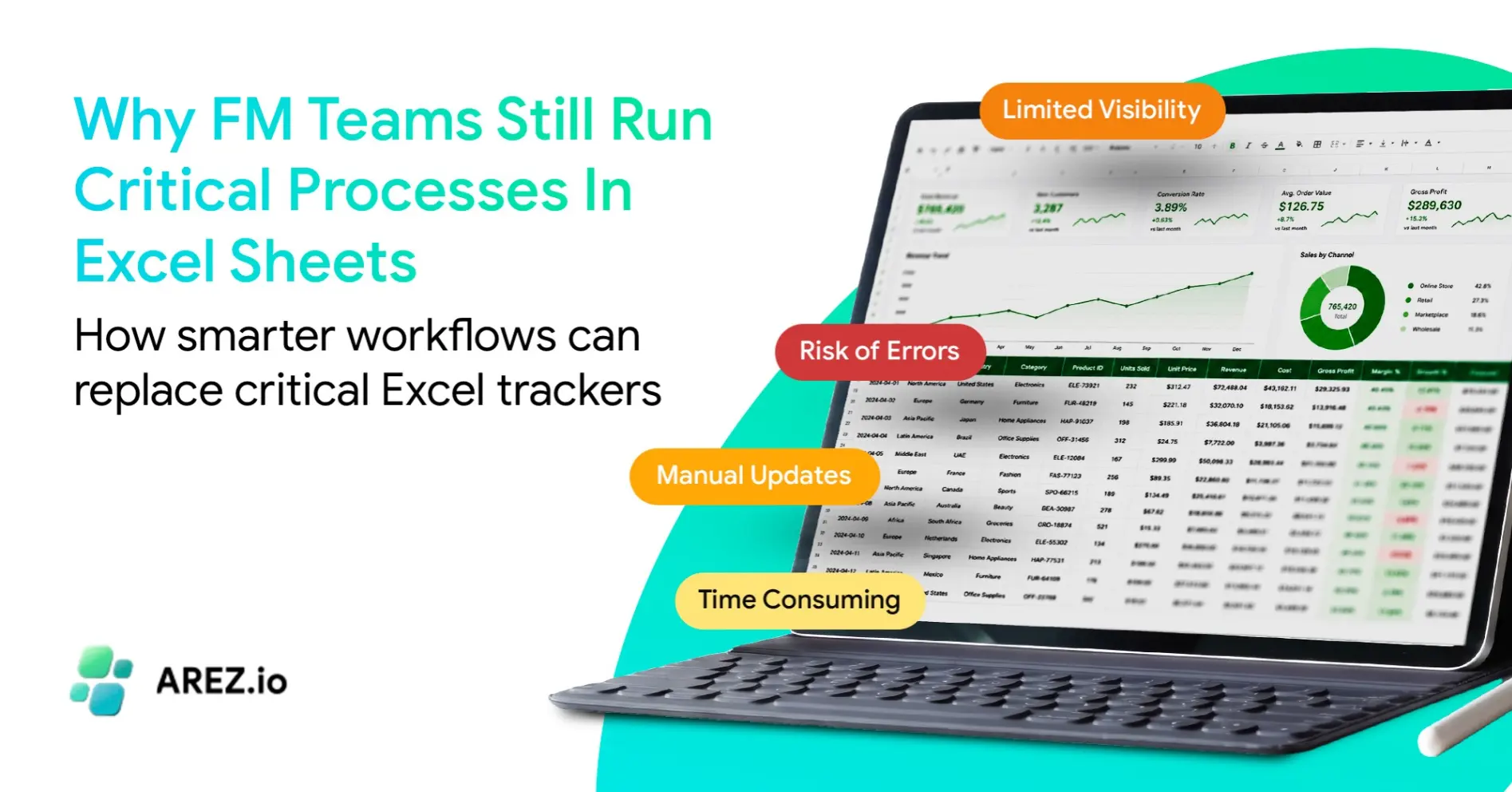
Facilities Management is an industry built on systems, yet many FM organisations still rely on spreadsheets to manage some of their most important operational processes. Quote trackers, budget planners, contractor performance logs, compliance registers and project schedules often exist outside the CAFM platform, resulting in spreadsheets that become critical to day-to-day operations.
Spreadsheets are usually a symptom of a larger issue. When teams cannot easily see approved works, future budgets, recurring failures or contractor performance within existing workflows, they create workarounds. Over time, these spreadsheets become operational control systems, helping teams manage information that is difficult to access elsewhere.
Workarounds In Practice
One of the most common workarounds we see when talking to customers is quote and budget management.
A quote may be approved, a supplier selected and the scope agreed, but that does not necessarily mean the work can proceed immediately. FM teams are constantly balancing budgets, priorities and planned programmes of work. As a result, approved jobs are often delayed until funding becomes available or a future delivery window is reached.
Because many systems struggle to manage this process, organisations create spreadsheets to track approved works, future budgets and planned delivery dates. Eventually the spreadsheet becomes the operational plan.
Imagine a helpdesk receives a call reporting failed lighting at a site. A reactive work order is raised and a contractor dispatched. However, there may already be an approved LED replacement project for that same site sitting in a spreadsheet awaiting budget release. The information exists somewhere within the organisation, but it is not visible within the workflow. The result can be duplicate work, unnecessary call-outs and wasted spend.
The organisation does not have a data problem. It has a visibility problem.
Spreadsheets and Hidden Insights
The same issue appears across many other operational processes. Consider a failed emergency lighting inspection. The remedial works are completed, the certificate uploaded and the job closed. The site becomes compliant again, so the issue disappears from day-to-day visibility. However, maintenance teams may still want to understand whether this is the first failure, the third failure in two years, or part of a wider pattern across similar assets.
In many organisations, that visibility is maintained through manual trackers and spreadsheets because the information is spread across multiple jobs, certificates and systems. The compliance issue may have been resolved, but the insight has been lost. Teams know the site is compliant today, but they struggle to identify recurring failures, recurring costs or assets that are becoming increasingly unreliable.
Similarly, maintenance teams often manage projects, remedial works and reactive jobs separately, making it difficult to understand how different activities relate to one another. Without connected workflows, organisations lose operational context. Teams can see individual jobs, but struggle to see the bigger picture.
As estates grow and contractor networks become more complex, this challenge becomes increasingly difficult to manage through spreadsheets and manual processes alone.
Why Traditional Systems Leave Gaps
Most CAFM and service management platforms were designed around individual workflows. They are very good at raising jobs, scheduling work, managing quotes and processing invoices. The challenge is that real operations rarely follow neat workflows.
Approved works need to be parked until budgets become available. Multiple work requests need to be grouped into larger projects. Compliance issues need to be linked to assets and historical failures. Different clients require different approval processes and business rules. When the software cannot support these scenarios, people create workarounds. Usually in Excel.
Moving Beyond Spreadsheets
The organisations gaining an advantage are not necessarily those with more software. They are the organisations that have reduced the number of places information needs to live.
This is where Arez takes a different approach.
Rather than forcing organisations to change their processes to fit the software, Arez is designed to adapt to the way organisations actually work. Workflows, approvals, compliance requirements and operational processes can be configured around the client's needs, helping bring information together without creating additional administrative burden.
Arez also recognises that no two FM operations are identical. While standard CAFM platforms often require organisations to adapt their processes around predefined workflows, Arez can be configured to support bespoke operational requirements. Whether that is managing approved works against future budgets, tracking recurring compliance failures, creating custom approval workflows, building client-specific processes or connecting previously disconnected activities, Arez can be tailored to reflect how the business actually operates.
The real benefit is not eliminating spreadsheets. It is ensuring that critical operational information is visible when decisions are being made.
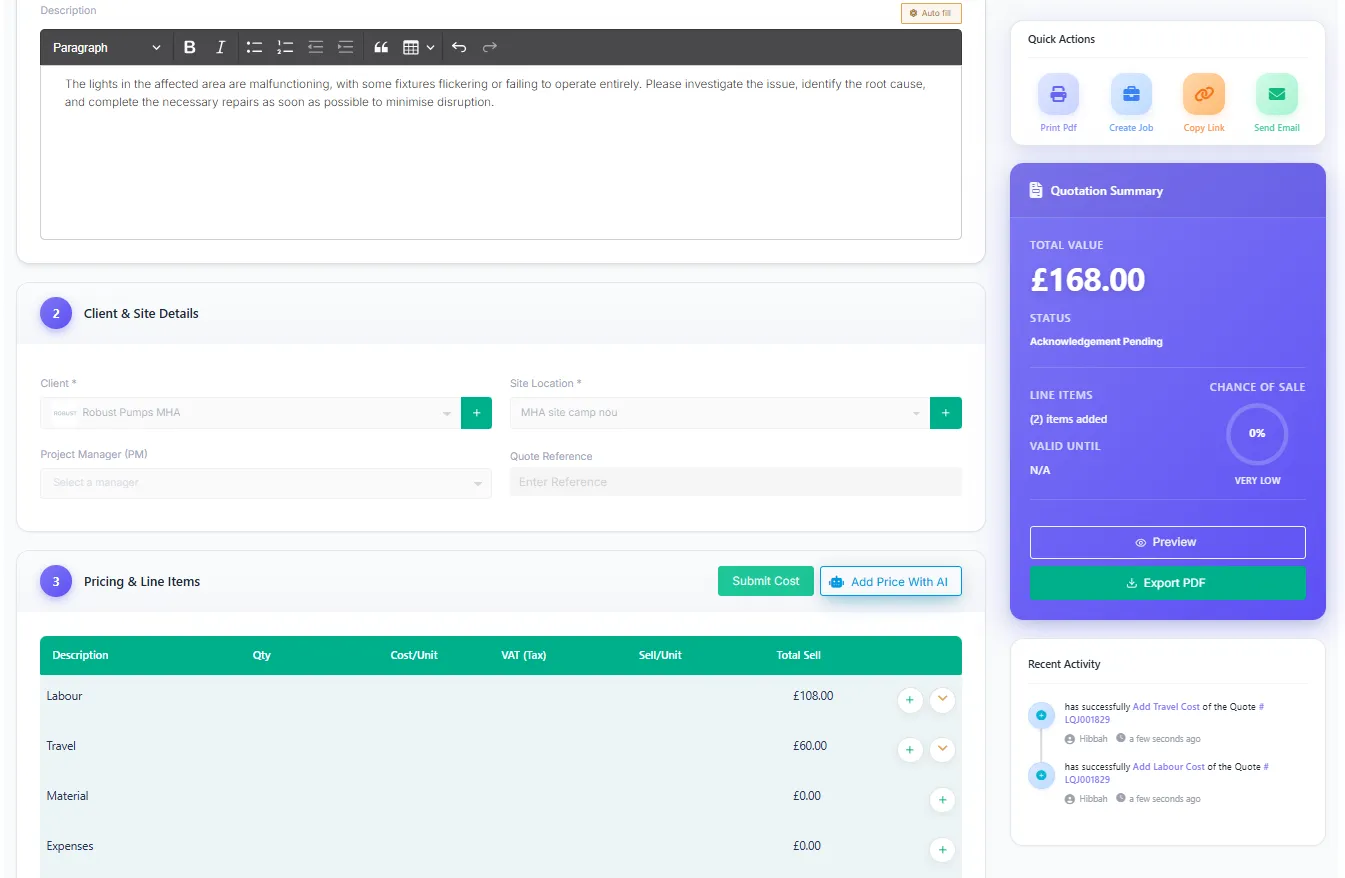
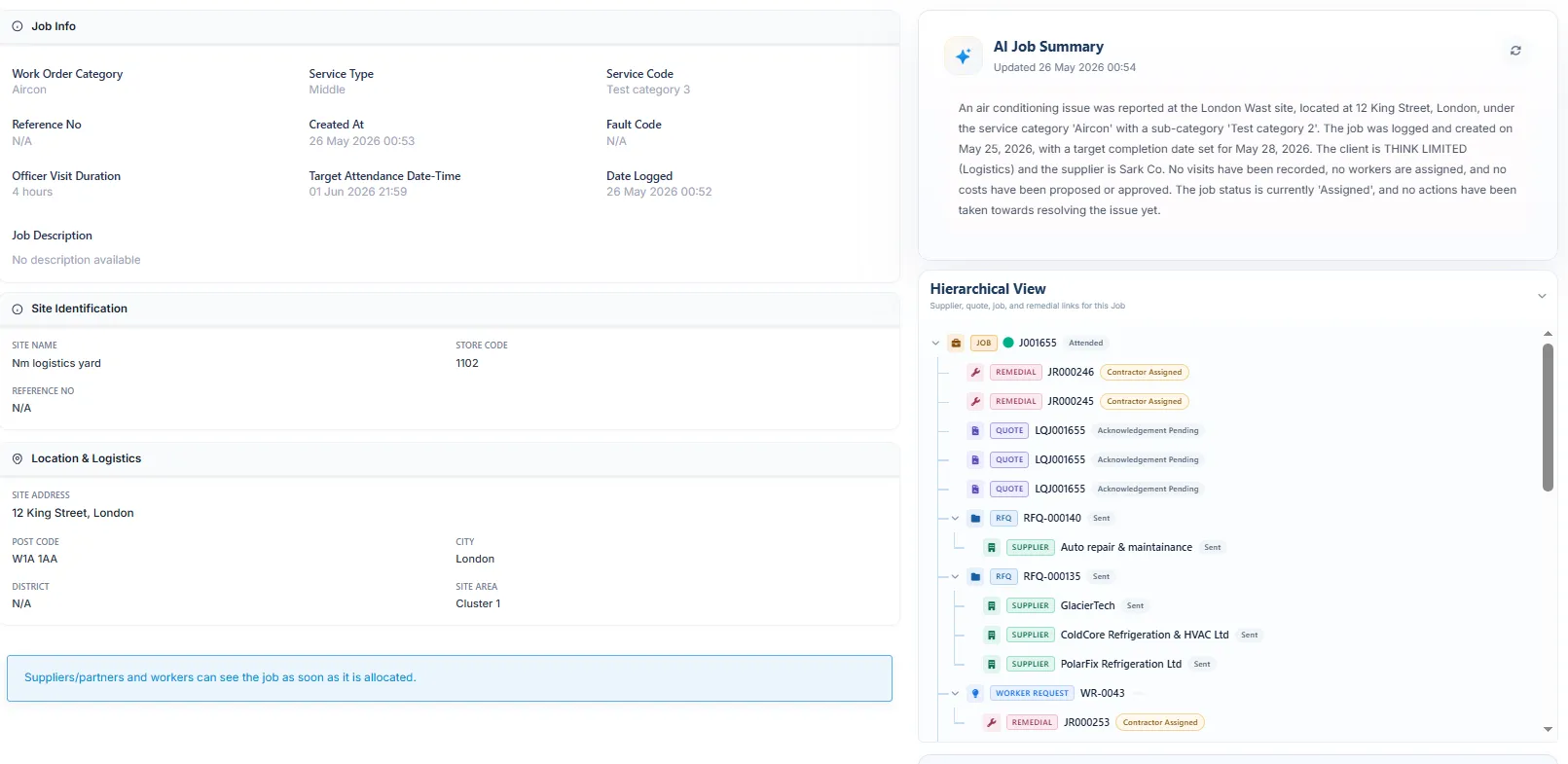
When a helpdesk receives a call, they can see planned projects as well as reactive jobs. When a compliance issue is resolved, the history remains visible. When budgets, quotes and delivery plans are connected, teams can make informed decisions without relying on separate trackers and manual processes.
The result is greater visibility, better operational oversight and a single view of the information needed to make informed decisions.
If you would like to see how Arez is helping FM businesses introduce AI in a practical and controlled way, book a free 20-minute demo and follow us on LinkedIn.