The £500,000 Live Wire: Why One Missed Compliance Control Can Cost an FM Contractor Everything
'%20fill='%230A2841'%3e%3cg%20id='Group-23'%20transform='translate(1030,%20300)'%3e%3cg%20id='Group-22'%20transform='translate(0,%2015)'%3e%3crect%20id='Rectangle-Copy-6'%20fill-opacity='0.08'%20x='0'%20y='0'%20width='36'%20height='36'%20rx='15'%3e%3c/rect%3e%3cg%20id='Group-3-Copy-10'%20transform='translate(14,%2011)'%3e%3cpath%20d='M1.48030663,7.00622181%20L0,7.00622181%20L0,4.54113581%20L1.47413869,4.54113581%20C1.47413869,4.01634435%201.4507005,3.52367128%201.48092343,3.03386591%20C1.50559521,2.63812154%201.54383646,2.23147985%201.66472817,1.85466237%20C2.01506741,0.761490221%202.84959027,0.135181726%204.05048903,0.0382530307%20C5.00096925,-0.0380281321%205.96501894,0.0233409237%206.94078773,0.0233409237%20L6.94078773,2.40813096%20C6.43008195,2.40813096%205.92986166,2.40755742%205.42964138,2.40813096%20C4.82209886,2.40927805%204.61238876,2.60428252%204.60868799,3.1778251%20C4.60622081,3.6183058%204.6080712,4.0587865%204.6080712,4.53540038%20L7,4.53540038%20C6.90686404,5.37449317%206.81804564,6.17515861%206.72676007,7.00105992%20L4.61979029,7.00105992%20L4.61979029,14%20L1.48030663,14%20L1.48030663,7.00622181%20Z'%20id='Fill-1'%3e%3c/path%3e%3c/g%3e%3c/g%3e%3c/g%3e%3c/g%3e%3c/g%3e%3c/svg%3e)


It was 10:43 on a Tuesday morning when the call came in. A routine reactive electrical fault at a busy 24/7 site for a major national supermarket chain.
The contractor’s helpdesk sprang into action. The job was logged, the nearest available engineer was dispatched, and by mid-afternoon, the system displayed a comforting, long-awaited green checkmark: Status: Completed.
The engineer had uploaded a quick photo of a closed panel. A generic certificate was filed away on a server somewhere. The invoice was queued up in the finance system, ready to send. On the surface, the process worked perfectly. The supermarket site was operational, the helpdesk team was busy, and everyone moved on to the next fire to put out.
Until two weeks later.
Another contractor attended the exact same site to carry out scheduled maintenance. As their engineer opened up the work area, he froze. A live wire had been left completely unattended, tucked dangerously behind temporary housing, left there sparking. He was inches away from a fatal shock.
Suddenly, a routine, closed work order wasn't just a completed job anymore. It was a full-blown health and safety investigation.
And the client had one simple, terrifying question: "Can you prove this work was completed safely, by the right qualified person, with the right evidence?"
This is exactly where field service compliance software and modern CAFM compliance software need to go beyond job tracking and document storage. Because when the client asked for proof, the contractor could not produce a clear, connected compliance trail.
The Uncomfortable Truth About "Job Done"
This is the exact moment many UK facilities management, electrical, HVAC, and building services contractors discover an uncomfortable truth: The job was completed on site, but the compliance trail was entirely broken in the back office.
For the contractor in our story, the issue wasn’t just the severe mistake the engineer made on site. The true commercial nightmare began when the panicked operations manager realised their software couldn't clearly prove who did the work, whether they were actually qualified and inducted for that specific job type, which RAMS (Risk Assessments and Method Statements) were approved, or which specific electrical certificate was issued.
Because of one broken audit trail, that contractor didn't just face an awkward meeting. They lost £500K in future work. The supermarket chain simply couldn't trust their operational controls anymore. The risk to their brand and public safety was too high.
For today’s FM teams, compliance is no longer just a box-ticking exercise or a PDF in a shared drive. It is a commercial control. One missing certificate, one wrong engineer, or one uncontrolled RAMS document can put your entire business at risk.
Why Your Software Might Be Setting You Up to Fail
Many contractors assume they are protected because they use digital field service software. But there is a massive, often hidden difference between software that records activity and software that controls compliance.
Standard platforms act as digital filing cabinets. They help you manage schedules, store PDFs, and track invoices. That’s useful for basic administration, but if you are a compliance-led FM contractor handling high-risk environments, a certificate sitting idly in a digital folder isn't enough to save you during an audit.
When the pressure is on, your system needs to answer one critical question instantly: Was the right qualified engineer sent to the right job, with the right controls, and can we prove it right now without rebuilding the paperwork?
This is the deeper compliance question that traditional systems often leave hanging. They record compliance activity after the fact but do not actively prevent failures in the first place. You are left relying on the hope that busy schedulers and rushed engineers will remember to manually double-check every credential, every time.
The Digital Gatekeeper: Stopping Risk Before It Reaches Site
Modern field service compliance software needs to act as a digital gatekeeper. It must stop risk from moving through your workflow unnoticed.
Instead of waiting for an audit to uncover a glaring hole in your paperwork, the system itself should dictate what is allowed to happen next based on real-time compliance data. This is the difference between a passive database and an active operational control mechanism.
| Compliance failure | What usually happens | What Arez FieldIQ should control |
|---|---|---|
| Wrong engineer dispatched | Scheduler picks the nearest available person | Competency and readiness checked before assignment |
| RAMS not controlled | PDF uploaded somewhere | RAMS linked, approved and version controlled by job |
| Certificate missing | Certificate chased after completion | Certificate tied to job, asset, engineer and client |
| Supplier gap | Documents tracked separately | Supplier readiness visible before allocation |
| Audit panic | Evidence rebuilt manually | Job pack built as work happens |
Expanding the Risk Points: Where Workflows Break Down
Most compliance failures are not caused by bad people. They are caused by busy teams working inside systems that allow too much manual interpretation. The scheduler is under pressure. The engineer is moving quickly. The subcontractor has sent documents before. The certificate exists somewhere. Everyone assumes someone else has checked. That is how risk passes quietly through the workflow.
When you rely on passive systems, compliance gaps naturally form in the white space between your office and the field. Here is where those catastrophic failures actually happen, and how a proactive system stops them.
1. The "Nearest" Engineer Isn't Always the "Compliant" Engineer.
In busy FM operations, dispatch is almost always driven by panic and geography. Who is closest? Who can get there today? But if the nearest engineer has an expired certification, or hasn't completed the site-specific induction, sending them is a massive liability.
A strong compliance system ensures that engineer competency actively shapes dispatch. If they don't have the right skills logged, the system flags them before they ever get behind the wheel. The workflow simply refuses to assign high-risk electrical work to an engineer whose credentials expired three days ago.
2. RAMS as an Operational Reality, Not Just Uploaded PDFs
We all have RAMS. But storing a massive, outdated PDF in a shared drive—or relying on a generic "read and sign" checkbox on a mobile app—won't survive a serious client investigation.
In our supermarket scenario, proving that the specific risk was assessed and the method statement was actually followed is paramount. RAMS need strict approval workflows, version control, and a hard, uneditable link to the specific job. They need to be front and centre for the engineer, not buried in a digital subfolder.
3. The Subcontractor Blind Spot:
FM contractors rely heavily on subcontractors for specialist work or geographic coverage. But if their compliance is managed on a side spreadsheet, gaps will inevitably go unnoticed.
A subcontractor company might be generally approved by your procurement team, but are the specific engineer's insurance, qualifications, and competencies still valid for this site? Supplier compliance must be brought directly into the CAFM workflow so that third-party risk is treated with the exact same rigour as your in-house team.
4. Unbreakable, Automated Audit Trails
When a client demands proof, you shouldn't have to spend two days frantically searching emails, messaging engineers on WhatsApp, and cross-referencing four different systems to piece together the story.
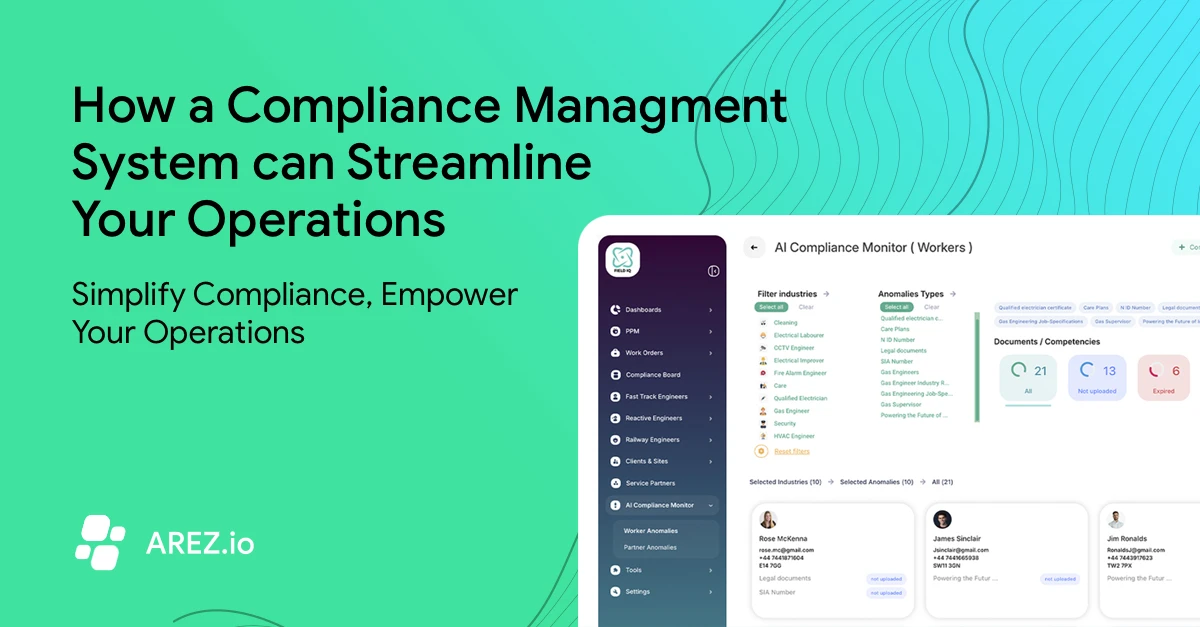
Photos, engineer notes, signed certificates, and asset updates should not be scattered across folders, emails and disconnected systems. They should build a cohesive, timestamped story around the job. In Arez FieldIQ, certificates, jobs, and work orders are linked to the site record, so compliance evidence can be linked back to the asset, job number, engineer profile, and the site’s GPS coordinates as part of a single connected operational history.
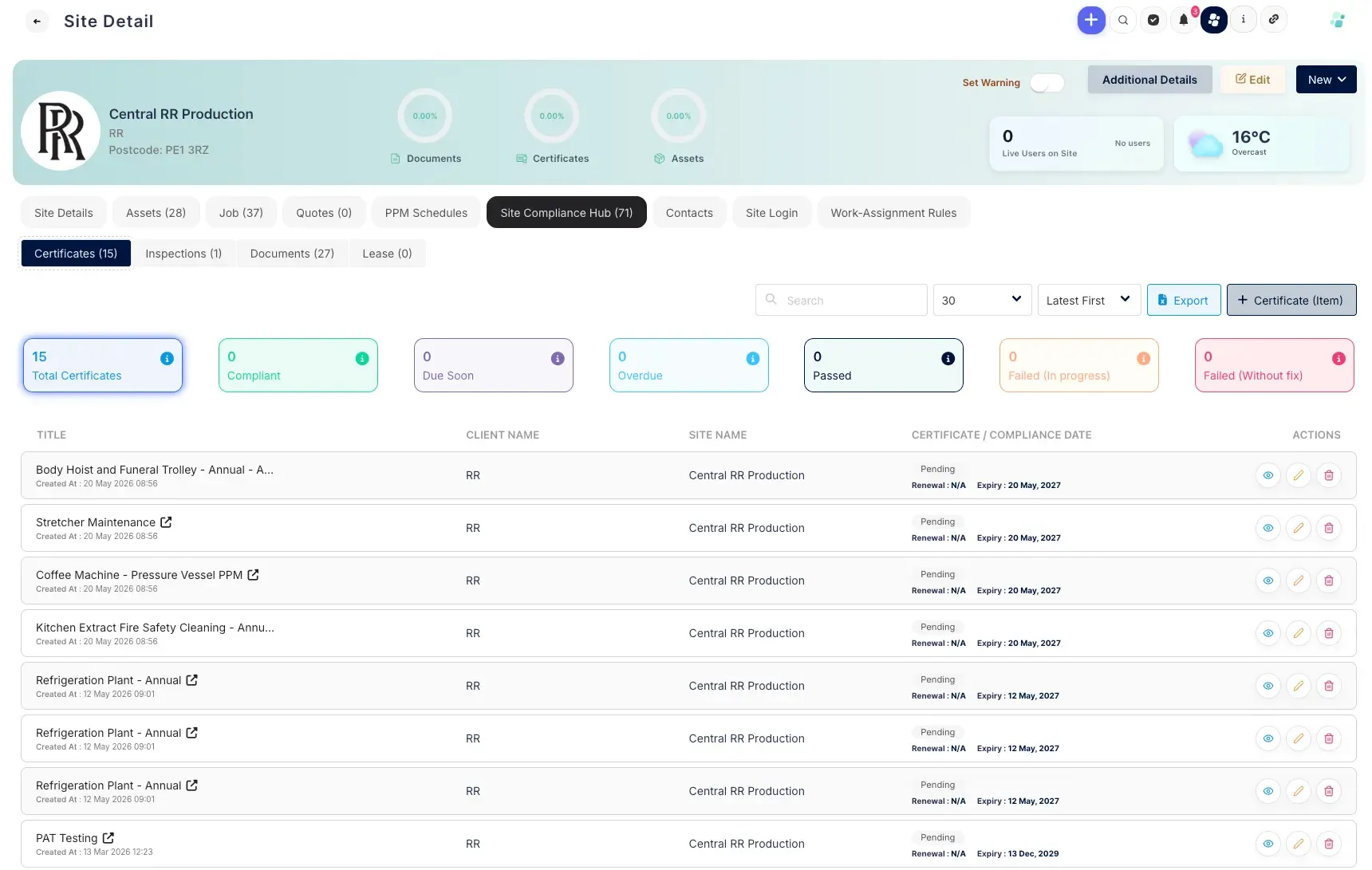
Arez FieldIQ Sites showing certificates, documents, assets & job-linked compliance records in one place.
If your team cannot prove engineering competency, RAMS approval, and job evidence within minutes, your compliance risk is probably sitting inside the workflow — not the filing system.
The Breaking Point: Graduating from Generic Field Service Software
For the contractor in our story, the aftermath was a wake-up call. They had not just lost future revenue; they had lost confidence in the way their operation controlled risk.
Many FM businesses use well-known field service platforms such as Joblogic to manage scheduling, dispatch, forms, certificates and invoices. Those tools can be useful for basic job management.
But compliance-led contractors need to ask a harder question:
Does the system simply record what happened, or does it actively stop a compliance failure from moving through the workflow?
When a serious client audit begins, a completed job status is not enough. A stored PDF is not enough. A mobile photo is not enough.
The system needs to prove that the right engineer was assigned, the right RAMS were approved, the right certificate was issued, the right evidence was captured, and the job pack was ready before the client had to ask.
That is where Arez FieldIQ is designed to go deeper.
Arez FieldIQ connects jobs, sites, assets, engineers, suppliers, RAMS, certificates, and evidence into a single compliance-aware CAFM workflow. It helps FM teams move from reactive paperwork to controlled, audit-ready operations.
Building the Ultimate, Audit-Ready Job Pack
One of the most profound shifts an FM business can make is to move from "Audit Panic" to "Audit Readiness."
When you use a proactive CAFM compliance system like Arez FieldIQ, evidence builds on its own. As the engineer completes the work, the software is quietly compiling the job pack in the background. The approved RAMS, the before-and-after photos, the engineer's live competency status, the digital signatures, and the asset updates are all woven together in real-time.
When a client asks for proof, there is no scrambling. There is no manual rebuilding of the timeline. Operations teams simply generate a comprehensive, client-ready job pack with a single click. This doesn't just save hours of administrative headache; it projects an image of total, unshakeable professionalism to your clients.
Compliance is a Contract-Winning Capability
The best FM contractors aren't just the ones who fix the problem the fastest. They are the ones who can hand over an ironclad, audit-ready package proving the work was done safely, correctly, and completely.
In today’s tight-margin market, compliance isn't just about avoiding a disaster like our fictional £500,000 live wire scenario. It’s about winning trust and securing long-term revenue. A contractor who tightly controls engineer readiness, locks down RAMS, effortlessly manages subcontractor gaps, and generates flawless job packs looks reliable, authoritative, and infinitely less risky to a procurement team.
Spreadsheets can track information, but they cannot control live risk. Old-school FSM platforms can record a job status, but they cannot prevent a compliance failure from reaching your client.
Don't wait for a near miss or a lost contract to find out whether your compliance trail is broken.
Ready to move from reactive paperwork to controlled, automated compliance? Start a free trial of Arez FieldIQ or book a demo today to see what true, audit-ready CAFM software looks like in action.
Book a Demo and get a free trial of AREZ FieldIQ