Security Providers: 4 Weeks to Prepare for the April 6 Labour Supply Liability Changes
'%20fill='%230A2841'%3e%3cg%20id='Group-23'%20transform='translate(1030,%20300)'%3e%3cg%20id='Group-22'%20transform='translate(0,%2015)'%3e%3crect%20id='Rectangle-Copy-6'%20fill-opacity='0.08'%20x='0'%20y='0'%20width='36'%20height='36'%20rx='15'%3e%3c/rect%3e%3cg%20id='Group-3-Copy-10'%20transform='translate(14,%2011)'%3e%3cpath%20d='M1.48030663,7.00622181%20L0,7.00622181%20L0,4.54113581%20L1.47413869,4.54113581%20C1.47413869,4.01634435%201.4507005,3.52367128%201.48092343,3.03386591%20C1.50559521,2.63812154%201.54383646,2.23147985%201.66472817,1.85466237%20C2.01506741,0.761490221%202.84959027,0.135181726%204.05048903,0.0382530307%20C5.00096925,-0.0380281321%205.96501894,0.0233409237%206.94078773,0.0233409237%20L6.94078773,2.40813096%20C6.43008195,2.40813096%205.92986166,2.40755742%205.42964138,2.40813096%20C4.82209886,2.40927805%204.61238876,2.60428252%204.60868799,3.1778251%20C4.60622081,3.6183058%204.6080712,4.0587865%204.6080712,4.53540038%20L7,4.53540038%20C6.90686404,5.37449317%206.81804564,6.17515861%206.72676007,7.00105992%20L4.61979029,7.00105992%20L4.61979029,14%20L1.48030663,14%20L1.48030663,7.00622181%20Z'%20id='Fill-1'%3e%3c/path%3e%3c/g%3e%3c/g%3e%3c/g%3e%3c/g%3e%3c/g%3e%3c/svg%3e)



Only four weeks remain before new labour supply liability rules take effect in the UK. For security providers who deploy officers through subcontractors or labour partners, this change means greater responsibility for oversight across the workforce supply chain. But many companies are still unaware of how this could affect their operations.
What Is Changing?
From 6 April 2026, new labour supply liability rules will come into force in the UK. The change targets labour supply chains that include umbrella companies and is designed to tackle non-compliance with PAYE and National Insurance.
The new rules introduce a form of joint and several liability in labour supply chains. In simple terms, this means that where workers are supplied through umbrella companies or similar arrangements, HMRC may be able to pursue other parties in the chain for unpaid PAYE or National Insurance if the umbrella company fails to meet its obligations.
The rules apply to payments made to workers on or after 6 April 2026.
For security providers that rely on subcontracted labour, this increases the importance of being able to demonstrate clear oversight of who is working on site and under what employment arrangement.
“The April 2026 liability changes mean security providers must be able to prove exactly who is working on site.”
Why This Matters for Security Providers
The security industry already operates in a regulated environment under the #Security Industry Authority (SIA). Providers must ensure that deployed officers hold valid licences and that operations meet regulatory expectations.
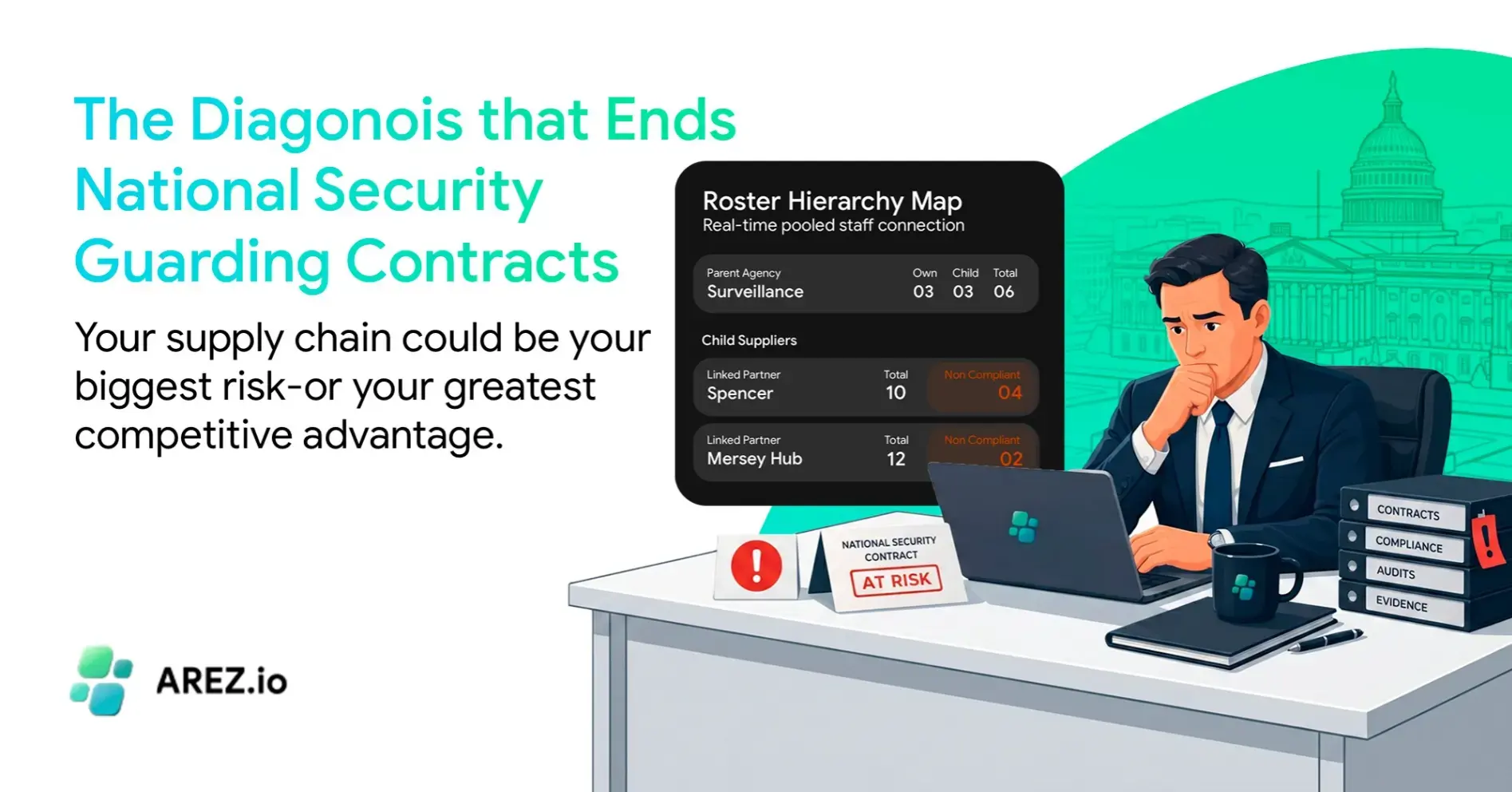
The new rules increase the importance of operational oversight across labour supply chains. In practice, this raises important questions for security providers:
- Who is actually turning up to work on site?
- Is the officer correctly licensed?
- Which organisation is responsible for the worker?
- Can you prove who worked, when, and under which labour provider?
Many rostering systems were designed primarily to schedule shifts and allocate resources, rather than to provide identity verification, licence validation, or compliance audit trails. As labour supply chains become more complex, this can leave companies with limited visibility over the individuals delivering services on site, creating potential financial, regulatory, and contractual risks if problems emerge within the workforce supply chain.
“Without clear workforce oversight, security providers risk financial exposure, regulatory scrutiny and contractual consequences.”
The Compliance Gap in Traditional Rostering Systems
Security providers commonly use workforce management platforms, such as systems similar to #Timegate and other rostering tools. These systems are excellent at managing schedules, assignments and client billing.
However, most were not built to:
- Verify the identity of workers at deployment
- Check licences in real time
- Validate employment or payroll arrangements
- Maintain a verifiable audit trail across subcontracted labour
As a result, many providers rely heavily on assurances from subcontractors. But under these new rules, documented oversight becomes far more important.
“Most rostering systems manage shifts well, but they were never designed to provide workforce compliance oversight.”
Strengthening Oversight Without Replacing Existing Systems
This is where Arez can help. Security providers are already using Arez on top of their existing rostering platforms to strengthen workforce oversight ahead of the April deadline. Working alongside systems such as Timegate, Arez adds a compliance layer that helps companies build a clearer audit trail across deployed workforces.
Arez supports security providers with:
- Facial ID verification at deployment
- Real-time BS7858 vetting, SIA licence validation, right-to-work documents, and expiry tracking
- PAYE compliance checks
- Verified attendance linked to worker identity
- Audit-ready workforce records
Importantly, these capabilities can be implemented without replacing existing rostering systems, allowing companies to strengthen controls while continuing to use their established operational platforms.

Arez keeps your operations audit-ready with automated compliance checks and real-time alerts.

With geofencing and the Arez.io app, officers can only clock in/out from the approved zone.

Secure book on/off via app with facial recognition, two-way photos and geolocation
Preparing Before April 6
With the 6 April deadline approaching quickly, security providers that rely on subcontracted labour should now be focusing on:
- reviewing labour supply arrangements
- strengthening workforce verification processes
- ensuring accurate records of deployments and identities
- improving visibility across subcontractor supply chains
Companies that cannot clearly demonstrate oversight of their workforce supply chain may find themselves exposed to unnecessary operational and compliance risk once the new rules take effect.
“Scheduling shifts is no longer enough. If your system can’t prove who was on site, you have a compliance gap.”
👉 If you'd like to see how Arez can help your business and be implemented alongside your existing rostering tools, you can book a short demo here: https://arez.io/book-a-demo