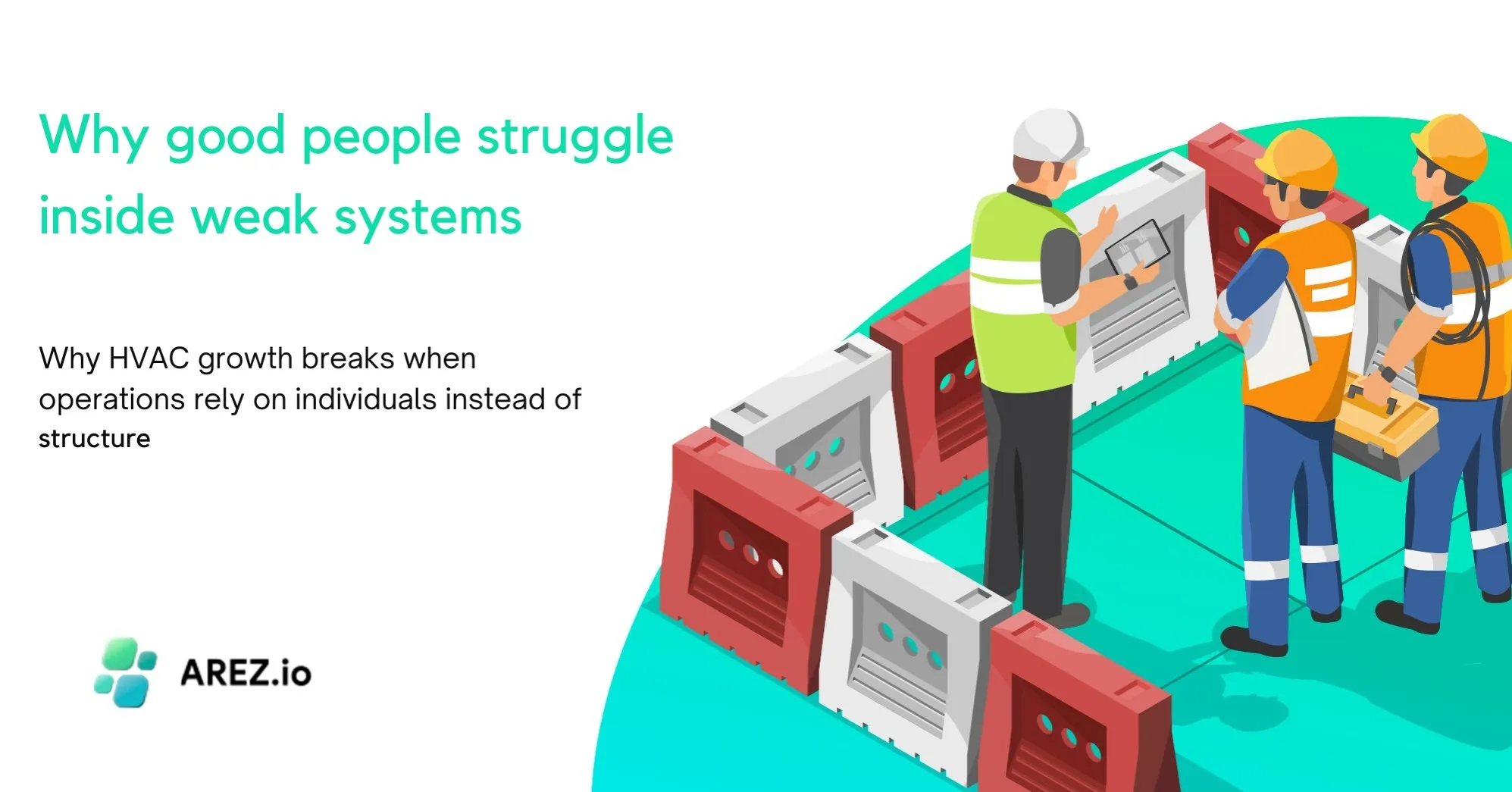
Why HVAC Businesses Don’t Have a People Problem. They Have a Systems Problem.
'%20fill='%230A2841'%3e%3cg%20id='Group-23'%20transform='translate(1030,%20300)'%3e%3cg%20id='Group-22'%20transform='translate(0,%2015)'%3e%3crect%20id='Rectangle-Copy-6'%20fill-opacity='0.08'%20x='0'%20y='0'%20width='36'%20height='36'%20rx='15'%3e%3c/rect%3e%3cg%20id='Group-3-Copy-10'%20transform='translate(14,%2011)'%3e%3cpath%20d='M1.48030663,7.00622181%20L0,7.00622181%20L0,4.54113581%20L1.47413869,4.54113581%20C1.47413869,4.01634435%201.4507005,3.52367128%201.48092343,3.03386591%20C1.50559521,2.63812154%201.54383646,2.23147985%201.66472817,1.85466237%20C2.01506741,0.761490221%202.84959027,0.135181726%204.05048903,0.0382530307%20C5.00096925,-0.0380281321%205.96501894,0.0233409237%206.94078773,0.0233409237%20L6.94078773,2.40813096%20C6.43008195,2.40813096%205.92986166,2.40755742%205.42964138,2.40813096%20C4.82209886,2.40927805%204.61238876,2.60428252%204.60868799,3.1778251%20C4.60622081,3.6183058%204.6080712,4.0587865%204.6080712,4.53540038%20L7,4.53540038%20C6.90686404,5.37449317%206.81804564,6.17515861%206.72676007,7.00105992%20L4.61979029,7.00105992%20L4.61979029,14%20L1.48030663,14%20L1.48030663,7.00622181%20Z'%20id='Fill-1'%3e%3c/path%3e%3c/g%3e%3c/g%3e%3c/g%3e%3c/g%3e%3c/g%3e%3c/svg%3e)


Most HVAC managing directors say the same thing at some point: “We need better people.”
More organised coordinators. More proactive ops managers. More experienced engineers. It sounds reasonable. It’s also often the wrong diagnosis.
Because for most small to mid HVAC businesses, the real problem isn’t the team. It’s that the business is trying to run a bigger operation on systems
designed for a much smaller one.
New Year’s resolution (for HVAC firms that actually want to grow)
It’s that week between Christmas and New Year where you swear you’re going to get your life together.
- You’ll do your receipts properly.
- You’ll stop living out of your inbox.
- You’ll finally label the van stock.
And then 2 January hits, and you’re back to: “Can someone check if we’ve got that certificate?” and “Where’s the photo from that job?” and “Why’s the
engineer at the wrong site?”
So here’s a more realistic resolution for 2026:
Run more sites with the same team without turning the office into a 24/7 WhatsApp helpdesk.
Not by hiring your way out of the problem. By tightening the system underneath it.
The uncomfortable truth about HVAC growth
HVAC growth looks great on paper.
You win more contracts. Add more sites. Take on a few bigger customers. Maybe you hire another engineer or two.
But then something else happens quietly in the background:
- admin multiplies
- Compliance becomes fragile
- Invoicing lags behind completed work
- Knowledge gets trapped in people’s heads
That’s when growth stops feeling like control… and starts feeling like stress.
The three pressures that hit first
If you’re scaling from “busy” to “proper operation”, these are usually the three things that bite.
1) Operational overwhelm
When you’re small, you can run the business on experience and common sense. When you’re growing, you end up running it on:
- WhatsApp threads
- Spreadsheets
- Inbox searches for certificates
- “Ask Sarah, she’ll know”
It works… until it doesn’t.
Example (domestic servicing):
You’ve got six engineers doing boiler services. One customer calls back saying, “you didn’t leave the paperwork.” The engineer did the job, but
the photo’s in his camera roll, the notes are in WhatsApp, and the office is now spending 20 minutes chasing evidence for a £90 service.
Example (commercial call-outs):
A retail client logs an urgent “no heating” job. Coordinator dispatches the nearest engineer. He arrives… and finds out it’s a different unit, a different
access route, a different plant room, and the site contact left early. That’s a repeat visit waiting to happen not because he’s incompetent, but
because the job didn’t carry the right context.
2) Cash flow friction
A lot of HVAC firms don’t have a “sales problem”. They have a handover problem.
Work gets completed on site… and then it stalls before it becomes cash.
Photos need chasing. Notes are scattered. Someone has to retype details. Someone has to match it to the right quote, agreement, or PO. Then
the invoice goes out late. Then the payment arrives later.
Example (planned maintenance / PPM):
You’ve completed monthly visits across 18 sites. The work’s done, but invoicing waits for someone to compile job sheets, match them to the contract
schedule, and confirm “what counts” this month. You’re effectively financing the client because your admin workflow is the bottleneck.
3) People pressure (caused by weak systems)
Recruitment is hard, no argument.
But even when you hire good people, weak systems force them into the wrong work:
- Coordinators become human routing engines
- Ops managers become professional chasers
- senior staff become the only source of truth
- Engineers waste time due to missing history or unclear scope
That’s not a motivation issue.
It’s a systems issue, and you can’t hire your way out of it long-term.
Why investing in CAFM matters (and not just for “big” companies)
This is where a decent CAFM / field service system actually earns its keep.
Not by adding shiny dashboards — but by removing the gaps where work gets lost between:
job → visit → evidence → compliance → invoice
To be clear: any serious CAFM system can help if it’s implemented properly and used day-to-day. The goal is simple:
Capture information once, at source and let the system carry the operational load.
That’s how you run more sites without doubling the admin team.
The “run more sites with the same team” test
If you want growth without chaos, your setup should make these things easy:
- Engineers can see asset history and job context on arrival
- Compliance evidence is captured as part of the job, not chased afterwards
- Job progress doesn’t rely on someone manually pushing it forward
- Invoicing is triggered by completed work, not someone’s reminder list
- reporting is available without monthly archaeology
That’s what separates a business that’s scaling… from one that’s just getting busier.
If you’re already reviewing CAFM options, Arez FieldIQ is one example built around connected workflows, jobs, PPM, assets, and compliance evidence and invoicing in one flow, with AI used to reduce admin rather than add complexity. Whether you choose FieldIQ or another platform, the principle holds:
If your operation only works because certain people hold it together, it’s fragile. The fix isn’t “better people”. It’s a better system.
👉 See how Arez supports HVAC businesses with a connected operational model.
👉 Request a demo to see how systems, not people, carry the operational load.